The Garden
Our garden is open for all to explore and find peace, inspiration and restoration. A place where many call in for quiet reflection, a chat with friends or to get involved.
Note: If you plan to make a special trip, please do check first (01235 550139) as very occasionally the garden is booked for a private celebration.
Seasonal Update: Summer 2026
Summer has definitely arrived, and by mid June we have already experienced two periods of very hot weather, with bursts of heavy downpours in between heatwaves. We are lucky at St Ethelwold’s that we have a permit to take water from the river which means we can keep the garden irrigated when necessary and therefore looking good for visitors.
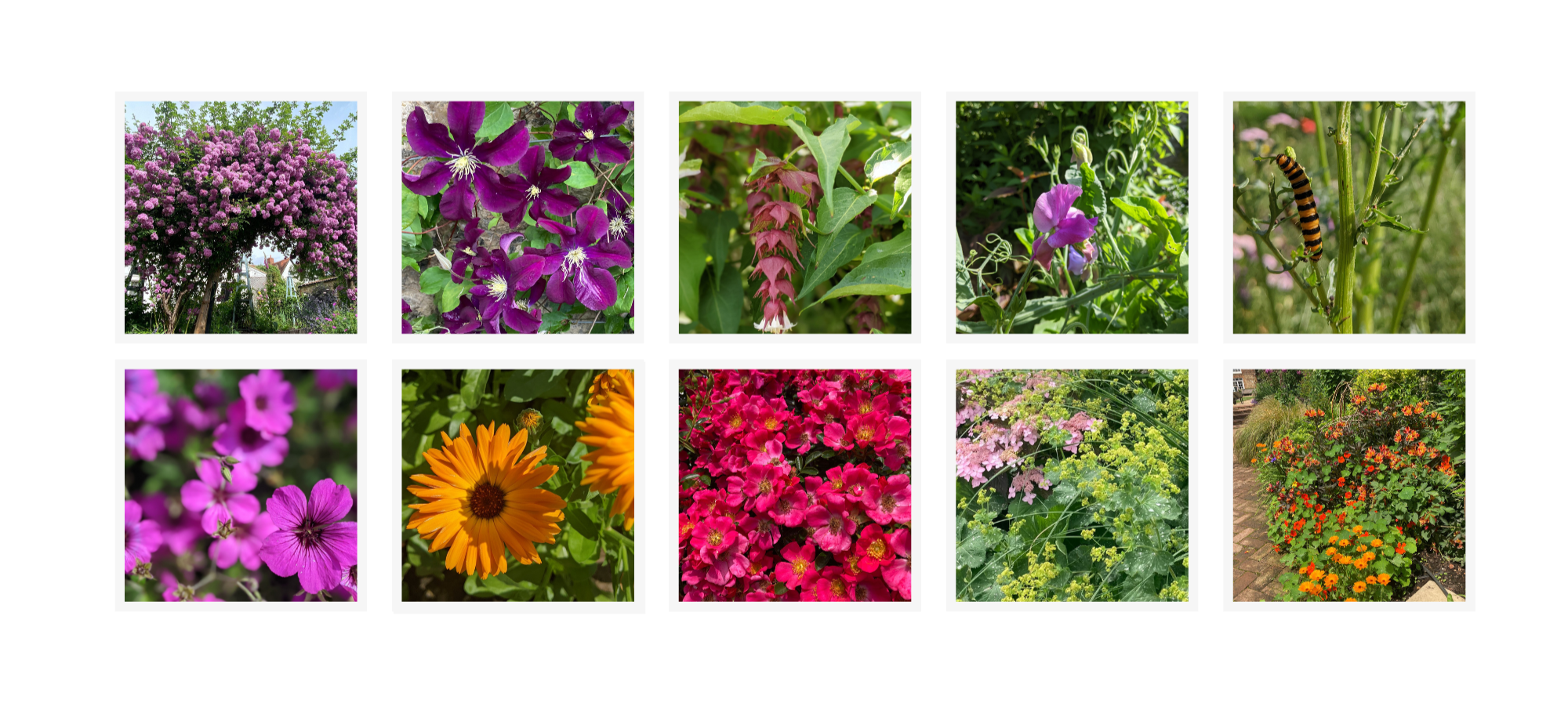
Plenty of summer rain plus good amounts of sunshine provided perfect conditions for the early flowers: iris, alliums, hardy geraniums and nepeta filled the borders. In particular the rambler Mannington Rose, scrambling over the swags across the garden, was better than we can remember for several years and the reliable rambler rose Kiftsgate covered the side of the house from ground to rooftop!
The early clematis did well this year: maroon Warsaw Nike in the drive, purple President and the huge flowered Henryii on the house. Mrs Cholmondeley looked fabulous and managed to match the colour of the iris planted nearby. They are now being replaced by the later flowering clematis throughout the garden (we have over 40 in total!).
As you enter the garden at this time of year, you will probably first notice the containers down the drive planted with a mixture of petunias, cosmos and nicotiana in a range of pale yellow and white. They are complemented by white cosmos and nicotiana in the first bed by the house, with a foamy background of clematis Paul Farges. This plant has to be fiercely managed, but nevertheless looks good as it rambles through shrubs and up walls.
The yellow south-facing border is not quite in total show-off mode at the time of writing, but will soon be in full flow. Dahlias are starting to flower and will continue their show through to October. The ever-reliable and long flowering alstromeria Indian Summer looks fantastic. At the back of the border yellow helianthus Summer Sun and sunflower Lemon Queen are already tall. The shrub Bupleurum Fruticosum clothes the wall with its dark foliage and yellow flower heads. And at the front of the border, there is a pretty profusion of nasturtium, marigold and Californian poppy. The removal of a very large and dark tree a year ago has enabled the extension of this sunny border.
Thankfully we have lots of shade in the garden, mainly from the large walnut tree that casts its shadow over the lower end of the lawn. So, whatever the weather, there is generally somewhere pleasant to sit – for sun worshippers or shade lovers alike! We have already welcomed lots of visitors and love hearing their comments about how they enjoy the garden. Our visitors’ book is full of appreciative comments, and it is wonderful to hear such positive feedback.
As the summer continues, and who knows how many more heatwaves we may have, the garden will continue to delight and be a place of peace, calm and tranquillity for our community. We will record the changes on this page as the seasons unfold.
The Garden Needs Ongoing Support
Please don’t feel you’ve missed the boat if you have gardening skills to share – call in at the Office weekday afternoons or email ethelwoldhouse@btinternet.com
Please keep feeding our bird box with kind donations towards the Garden Fund. Some visitors give a donation in thanks for a place of peace and restoration, some in memory of a loved one: all help keep the Garden beautiful through all the seasons. You can also call in at the Office on weekday afternoons to give something, or make a bank transfer (reference ‘Garden’) to:
The Fellowship of St Ethelwold’s
Sort code 30-67-53
Acc No 27739260
We would like to acknowledge any gift, so do email us with your contact details if you make a donation.
And please keep coming to enjoy the peace and beauty of the garden in all seasons.

What The Gardeners Really Think
-
‘I started in Jan 2012, having met Susie (Trustee and volunteer gardener) on a RHS gardening course at Waterperry in 2006/7. Susie asked for help with a big garden in Abingdon, but I had no idea what to expect…. I have since learned to expect the unexpected at St Eth’s!
‘It was an eyeopener to see the comings and goings of different people as the garden is very much open to all, and you never know who else might be around or what questions you might be asked. One day I was up a ladder tying in rambling roses surrounded by a large group who were drawing in the garden. I later went for lunch, leaving my tools under a chair, and when I got back there was a group meditating around my tools! I crept in and retrieved them. On some afternoons this last summer we had a choir singing. No two days are the same.
‘I do whatever jobs I see need doing. I’m an experienced gardener, having enjoyed it since as a child my grandmother gave me a little plot to tend. I like being left and trusted to do what I want to – having scope to use my initiative. I prefer weeding, edging the lawns and tidying up to planting things, which I am not so keen on.
‘I don’t have a favourite part of the garden, I like the way it all works as a whole, but the yellow border when at its best is beautiful.
‘I’d tell anyone to have a look and explore the garden, it’s a hidden gem in the middle of town.’
-
‘I’ve known the garden on and off for about 25 years, and got involved as a gardener four years ago. I could see work needed to be done around the walls and the roses and I offered to come and do some ladder work. As time went on I could see more and more possibilities, and a vision forms as you get to know a garden.
‘There are small changes – moving the stone trough from outside the Hearth to the River Room and planting alpines, and big changes – uprooting the ornamental cherry outside the Hearth. It didn’t have enough garden value, was making the Hearth very dark, and had electric cables through it.
‘In digging by the cottage we found slabs of thin stone that may have been in place when the cottage was used as stables. Now we’ve made a feature of this on the threshold, with thyme planted to creep around. We have some debate, with different ideas about what to do, but often things just evolve.
‘My favourite plant in the garden is the perennial evening primrose, it sprawls over the brick path and is lovely. It needs a lot of attention as the flowers only last one day, and so continual deadheading is needed.
‘The new volunteer gardeners are splendid, they make a difference as there’s a lot to do.
‘To me, the garden has a sympathetic ambience. People come in crisis or distress, or to rendezvous with friends. Mothers can feed babies, toddlers can play. Yoga classes come, and there’s meditation, French groups too. It’s lovely to see.
‘I’d like it to have some more little paths that children could explore, it would give us a chance to grow more individual plants that are not part of the bigger scheme. Nooks and crannies.’
-
‘I’ve known thegarden well over about seven years, since moving to Abingdon. I come with friends and family, and like to show it to people who haven’t found it – a special, almost secret garden. People sometimes hover at the gate wondering “are we allowed in?” and need encouragement to come and explore.
‘This year I have retired, and just at the right moment I saw the appeal for help in the garden – I responded immediately! It’s great being outdoors, being active and working with a group of other people.
‘To begin I was told how I could help – pruning, deadheading and weeding. Early on I was given a big job, the pruning of the rose on the wall, which was so satisfying to do. In early summer I love the pale blue iris, so was really happy to be involved in lifting them all, cutting back and replanting, learning from others how to do it properly. In full summer the herbaceous border is beautiful.
‘I used to work in a school, and am glad to have been given the task of supervising a group of teenage schoolboys who come to help one afternoon each week.
‘The garden is an absolute little gem with a unique atmosphere. It’s good to be welcomed by the team, get involved and go with the flow.’


